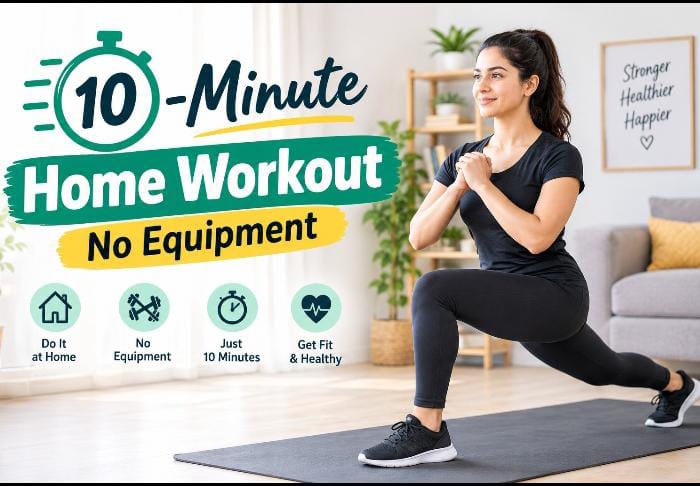
Starting to exercise can feel like a lot. Gym memberships cost money, the equipment looks confusing, and most plans online are written for people who already train. The good news is that the best home workout for beginners needs no gym, no weights, and no special skills. You need a small patch of floor and about 20 minutes.
This guide gives you a beginner workout at Best Home Workout for Beginners that is gentle on your body, easy to follow, and built around what health experts actually recommend.
Why Start a Home Workout Routine?
Many people are not moving enough. A WHO-led study found that more than 31 percent of adults, about 1.8 billion people, did not reach the recommended level of physical activity in 2022. If you have been inactive, you are far from alone.
Working out at home removes the usual excuses. There is no travel time, no waiting for machines, and no feeling watched. You can exercise in your living room, before work or after dinner.
How Much Exercise Do Beginners Really Need?
WHO advises that healthy adults aged 18 to 64 aim for 150 to 300 minutes of moderate-intensity aerobic activity a week, or 75 to 150 minutes of vigorous activity. It also notes that muscle-strengthening activity on at least two days a week gives extra benefits. yahooyahoo
That sounds like a lot at first, but you do not have to start there. WHO stresses that some physical activity is better than doing none. Treat those numbers as a destination, not a day-one requirement. who
Safety First
Before you begin, keep these in mind:
- If you have a heart condition, joint pain, high blood pressure, or you are pregnant, check with your doctor first.
- Wear comfortable shoes with grip, or train barefoot on a non-slip surface.
- Mild muscle soreness is normal. Sharp pain, dizziness, or chest discomfort means stop.
The Best Home Workout for Beginners (No Equipment)
This routine mixes cardio, lower body, upper body, and core, so you train the whole body in one short session.
Step 1: Warm Up (3 minutes)
Never skip this. It raises your heart rate slowly and prepares your joints.
- March in place: 60 seconds
- Arm circles: 30 seconds forward, 30 seconds back
- Hip circles: 30 seconds each direction
- Gentle shoulder rolls: 30 seconds
Step 2: The Main Circuit (about 12 minutes)
Do each move for 30 seconds, rest for 30 seconds, then go to the next. Complete the full list twice.
- Bodyweight squats work your thighs and glutes. Push your hips back as if sitting on a chair, and keep your chest up.
- Wall push-ups build chest and arm strength with less strain than floor push-ups. Place your hands on a wall, lean in, and press back.
- Glute bridges protect your lower back and wake up your hips. Lie on your back, knees bent, and lift your hips.
- Standing knee lifts add light cardio. Lift one knee at a time to hip height.
- Plank on knees trains your core. Keep a straight line from shoulders to knees.
- Reverse lunges (hold a chair if needed) improve balance and leg strength. Step back gently and lower slowly.
Step 3: Cool Down (3 minutes)
Slow your breathing and stretch the muscles you used:
- Quad stretch: 20 seconds each leg
- Hamstring stretch: 20 seconds each leg
- Child's pose: 30 seconds
- Chest opener against a wall: 20 seconds each side
A Simple Weekly Schedule
Consistency matters more than intensity. Use this as your starting point.
How to Progress Over 4 Weeks
- Week 1: One round of the circuit, 20 seconds of work and 40 seconds of rest.
- Week 2: One round, 30 seconds of work and 30 seconds of rest.
- Week 3: Two rounds, 30 seconds of work and 30 seconds of rest.
- Week 4: Two rounds, 40 seconds of work and 20 seconds of rest.
Small increases like these let your body adapt without burning you out.
Common Mistakes Beginners Make
Doing Too Much, Too Soon
Going all out on day one often ends with sore muscles and a quit by day five. Start easier than you think you need to.
Skipping Rest Days
Muscles get stronger while you recover, not while you train. Rest days are part of the plan.
Ignoring Form
Ten slow, controlled squats beat thirty rushed ones. Quality protects your joints and gives better results.
Comparing Yourself to Others
Social media is full of people who have trained for years. Compare yourself only to the person you were last week.
Tips to Stay Consistent
- Pick a fixed time. Morning, lunch break, or evening, whichever you will actually keep.
- Start tiny on bad days. Even five minutes keeps the habit alive.
- Track it. Tick off each session on a calendar.
- Make it enjoyable. Play music or a podcast.
- Pair it with something you already do, like exercising right after your morning tea.
Final Thoughts
The best home workout for beginners is the one you will repeat. You do not need fancy gear or an hour a day. Start with the simple circuit above, follow the 4-week progression, and build up slowly toward the activity levels WHO recommends. In a month, those first sessions will feel easy, and that is when you know it is working.
FAQs
What is the best home workout for beginners with no equipment?
A mix of bodyweight squats, wall push-ups, glute bridges, knee lifts, and knee planks, done as a short circuit three times a week.
How many days a week should a beginner work out at home?
Three strength sessions plus two light cardio days, such as brisk walks, is a good start. Keep two days for rest.
How long should a beginner workout be?
Twenty minutes, including warm-up and cool-down, is enough. Increase gradually as you get stronger.
Can I lose weight with a beginner home workout?
Regular exercise supports weight control, but results also depend on your eating, sleep, and consistency. Exercise works best alongside a balanced diet.
Do beginners need to warm up at home?
Yes. A 3-minute warm-up lowers injury risk and makes the workout feel easier.